In our “5 Questions for…” section, Hotelcore employees, customers, partners and industry experts provide brief insights into trends and practical knowledge from the hotel industry. This time, we talk to DI Michael Kössner, Managing Director of CapCorn touristic software, about how hotels use a smart PMS interface to digitally map processes such as pre-check-in & Co., accelerate workflows – and why the collaboration between CapCorn and Hotelcore makes all the difference in practice.
What challenges do hotels solve in their day-to-day operations with CapCorn’s hotel software – and which processes benefit most from PMS-based digitalisation?
Hotels today face two main challenges: a lack of time at reception and ever-increasing guest expectations in terms of speed and service. This is exactly where our CapHotel hotel software comes in: it bundles all core processes relating to reservations, guest management, billing, registration data and communication – so that employees spend less time on administration and have more time for genuine hospitality.
The processes that benefit most are those that occur several times a day and otherwise require a lot of manual work – for example:
- Check-in & registration form
- Guest communication before arrival
- Payment processing & check-out
- Price and channel management
In short, everything that currently involves paperwork or copy-paste tasks will become noticeably faster and more secure thanks to PMS-based digitalisation.
What exactly happens between CapCorn and Hotelcore? Which processes in the hotel become noticeably easier when PMS (property management system) and digital guest folder are connected?
Behind the scenes, CapCorn and Hotelcore do exactly what hoteliers want: data is synchronised automatically, without any manual effort on the part of the team.
Specifically, this means:
- Reservation and guest data is transferred from the PMS to Hotelcore
- Pre-check-in information flows back in a structured manner
- Registration data, arrival information and payments can be prepared digitally
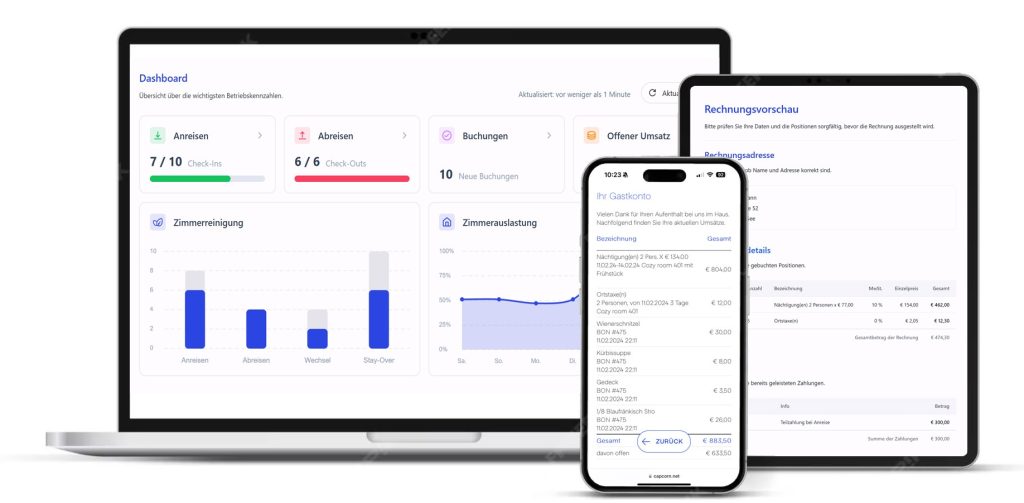
- Invoices and outstanding payments are pulled directly from our PMS and displayed in the digital guest folder
- This has an immediate impact in the hotel because:
- there are fewer queries (“When is check-in? Where do we park?”)
- Less manual data entry is required
- Check-in and check-out are significantly faster
The connection between PMS and guest folder is therefore not just a “nice to have”, but a real productivity lever.
How does the guest journey change when processes such as pre-check-in, registration/data entry, arrival information, check-out and payment are digitally consolidated in one place – and what are the typical stumbling blocks during implementation?
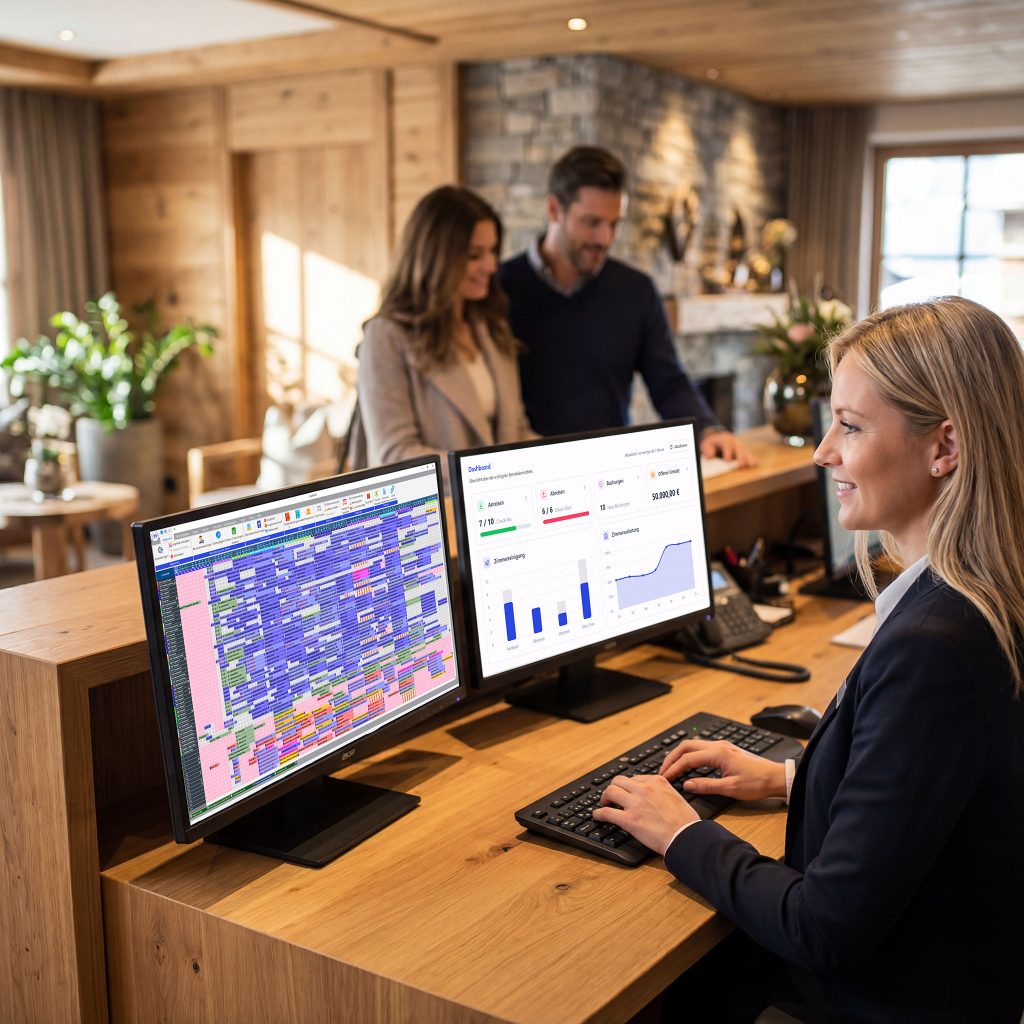
The guest journey changes noticeably: the stay no longer begins at the reception desk, but at home on the smartphone. Guests can enter data, read information and prepare everything at their leisure – and there is more room in the hotel for a personal welcome and valuable holiday time:
Verifiable effects in practice:
- Check-in no longer takes 5–10 minutes, but often only 1–2 minutes
- The team has to make fewer phone calls and answer fewer emails.
- Guests feel better informed and looked after
However, realistically speaking, there are some typical stumbling blocks during implementation:
- Communication with guests
Guests must be actively informed about the digital process, otherwise the service will unfortunately not be used. - Process thinking instead of tool thinking
Not “we are installing a digital guest folder”, but: What should the process look like for us in the future? - Acceptance within the team
If employees are not involved, digitalisation will be perceived as additional work. - Data quality & responsibilities
Who maintains content such as arrival information, opening hours and FAQs? This must be clearly defined.
However, with a smooth introduction, it can very quickly become a real advantage – both for guests and for the team.
When you think of an “optimally digitalised hotel”, which three steps/automations would save the most time for the reception and team?
When we think of quick wins for the team, the following three automations save valuable time right away:
- Automated pre-check-in including registration data
Guests enter their details digitally in advance. This massively reduces check-in time and prevents errors. Guest registrations on site are recorded digitally on a tablet.
- Automatic guest communication before arrival
For example, arrival emails are sent automatically 3 days before arrival: ideally, these contain arrival information, route recommendations, parking, check-in time, upselling (breakfast, late check-out, etc.). This saves queries and increases additional revenue at the same time.
- Digital guest account including check-out and payment
During their stay, guests can conveniently check their transactions on their guest account, pay digitally before departure and enjoy a queue-free departure.
This takes a huge load off the reception team, especially during peak times.
These three steps often result in a measurable reduction in effort within the first few weeks – without having to turn the entire hotel upside down.
There are countless PMS and guest journey solutions. What three criteria should hoteliers definitely check in order to find the right mix of providers and avoid making the wrong decisions?
Our experience shows that the following criteria are important:
- Software fits the hotel – not the other way around
As a provider, we need to understand typical hotel operations and always ensure in advance that we can map these with our software.
- Implementation & support
It is not only the software that is crucial, but also how well onboarding, training and support work – especially in stressful phases. CapCorn offers an “all-inclusive” package for customers – no hidden costs – support and updates are included free of charge.
- Various interfaces have been tested in production
It’s not just a question of “we can import data”, but rather: does it work in everyday life – stably and automatically? The key here is cooperation between providers: clear responsibilities, short communication channels and a shared understanding of the guest journey. This is exactly where a strong partnership comes into its own – as between CapCorn and Hotelcore: our systems are coordinated so that hotels can deliver a much more consistent experience to their guests, without isolated solutions, without duplicate data maintenance and with significantly less friction.
By checking these points, you can avoid classic mistakes and find the right partners for the long term.
Michael Kössner in conversation with Sandra Schneider, Hotelcore