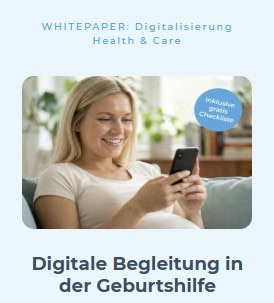
The midwife is currently looking after three women at the same time, so any enquiries about the hospital bag, admission or breastfeeding advice end up on the answering machine. The leaflets in the waiting room are out of date, and expectant parents – who have been scouring pregnancy apps and review sites for months – are left with unanswered questions on the day of admission. Our new white paper shows why structured digital patient support in obstetrics is not a luxury today, but a necessity.
What is a digital birth companion?
A digital birth companion is an app- or browser-based information and communication solution that supports expectant parents throughout their entire stay at the hospital: from initial registration right through to postnatal care after discharge. Unlike traditional leaflets or information evenings, the system provides relevant content in a structured, multilingual format exactly when it is needed, regardless of the availability of clinical staff. This does not replace personal support, but rather specifically alleviates the burden on staff.
Why communication gaps in obstetrics are not merely a matter of convenience
72% of preventable adverse events in obstetrics are attributable to communication errors. This is the finding of the TeamBaby research project at Frankfurt University Hospital. At the same time, according to the German Midwives’ Association, delivery room midwives often care for up to four women simultaneously – twice as many as in other European countries. Under these conditions, a structured flow of information is not a matter of service quality, but a safety measure.
Added to this is structural pressure: by 2035, at least 300,000 hospital staff will be leaving the workforce due to retirement. The white paper breaks down in detail what this means in practical terms for maternity clinics and how digital solutions can address this challenge.

What does the digital patient journey look like in practice?
Structured patient support treats the hospital stay as a coherent experience. Before admission, expectant parents receive checklists, birth plan templates and course registration forms. On the maternity ward, meal plans, breastfeeding counselling bookings and chat with the team are all managed via a single channel. And after discharge – precisely the moment when around 41 per cent of mothers in Germany do not receive midwifery care – push notifications containing postnatal care information accompany the family home.
An internal evaluation by Gastfreund GmbH based on data from pilot hospitals shows that the usage rate is between 90 and 92 per cent. On average, 3.5 times as many people use the digital service each month as there are births. The system is therefore not only accessed in the delivery room, but is actively used during the run-up to the birth and in the postnatal period.
To find out which specific content has the greatest impact at which stage, and how this affects the volume of enquiries on the ward, read the full white paper.

Does digital communication replace personal care?
This is a question that hospital managers are right to ask. The answer is clear: no. Digital systems take over the tasks that take up nursing staff and midwives’ time every day, tasks that do not form part of their core duties: answering the same question for the tenth time about visiting hours, packing lists and discharge documents. By handing over these routine tasks, staff free up capacity for what is only possible through personal contact: emotional support, situational assessment and individual attention.
Facilities using the system also report an unexpected side effect: job applicants actively mention digital birth support during interviews. At a time of a midwife shortage, this is no small sign.
Conclusion
Communication gaps in obstetrics do not arise from indifference, but from structural bottlenecks. Digital patient support addresses precisely these gaps: reliable information, bridging language barriers and providing tangible relief for the team. The white paper by Gastfreund GmbH provides the data, the areas for action and a concrete guide to implementation.
👉 Download the full white paper for free: Digital Support in Obstetrics – All Challenges, Solutions and Selection Criteria for Decision-Makers in Maternity Clinics.